
As a developer, nothing feels better than when I write some code and immediately reap the benefits of that work. Momentum has improved a lot these last few months in large part because of the focus of development. Connect is making good progress toward a compelling, enjoyable tool from a fragile spare-time project.
Moving from Foundation to Features
Although mensagod and the Mensago platform design documents have had some adjustments here and there, Connect continues to be the focus, and the benefits have been immediate. Since the last post in… *checks notes*… November(?!), stability has improved and new features are getting added. The last part of November saw more cleanup in device sync and work on a command execution subsystem. This is a program component that makes it easy for other parts of the program to tell it to do something in a very simple, generic way. The initial reason for it was a fix for keyboard shortcuts that have the same combination in different activity modes, but it also paves the way for building a command palette. If you search online for Superhuman Command, you’ll get an idea of what I’m referring to. For heavy keyboard users who are still learning shortcuts, it’s really helpful.
December saw some new features and prep work for future ones. One new feature was proper handling of passwords when you sign up for an account. The password strength is shown to you like on many websites, but the way it’s implemented is better than most. Judging the strength of a password seems easy on the surface, but the devil’s in the details. The engineers over at Dropbox developed a way of estimating password strength that’s pretty good–to the point of writing an academic paper on it. The software library is called zxcvbn, and Connect leverages it to help people make better passwords that aren’t as easy to break. Foundation code was written for a flexible settings system that will let you sync certain settings across applications, such as between Connect and some Android app made down the road. Connect now tracks when you last responded to a message, and now it’s possible to import contact information using a CSV file from Outlook or Gmail.
Building Up Messaging
January was the start of a focus on the messaging portion of Connect and it has continued up to now. Saving message drafts, which seems like a really easy task, turned out to be very involved because of how Mensago’s pervasive encryption changes how the Connect interacts with your data. Work on message drafts continued all the way into the last week or so before they started to be stable for day-to-day use. Blocklist management has been implemented, and while other programs like Outlook have this ability, it’s not nearly as easy as it should be. Connect now has its own window for blocking people you don’t want to hear from, and if it’s for an entire organization, you can block them, too. Doing so prevents them from even sending you a Contact Request. February was spent working on message attachments and fixing bugs in message drafts, which turned out to be a lot more work than expected.
Introducing Attachment Guard
One feature is just now falling into place that I’ve been earnestly waiting for since close to the project’s start; a feature I call Attachment Guard. Attachment Guard helps people make decisions about whether or not an attachment is both legitimate and safe. It does this by performing some checking the attachment and providing a color and a number to show how risky the file is.
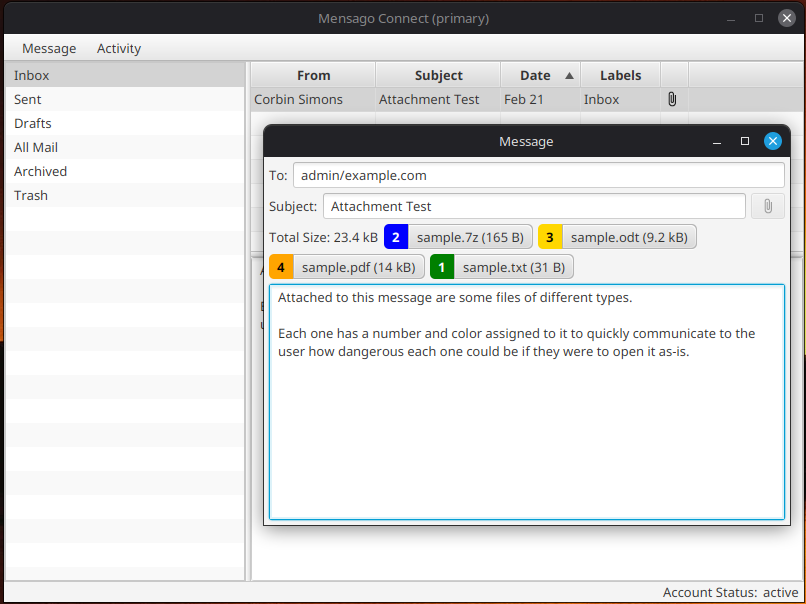
By communicating the riskiness of a file, people can decide for themselves if they want open it. For example, most people don’t know that Word documents and PDFs can be used in cyberattacks. On its own, this information is helpful, but in the future it will be used alongside other features I have planned to provide even more guidance.
Why is Attachment Guard important? Because I’ve seen firsthand in my job countless instances where nontechnical users click on a link in a malicious PDF, open a malicious PDF, or ask me if something safe. They don’t know how to judge the risks, so if software can help them make a decision, it should.
Next Steps
The goal is an alpha release before the year’s end, and while it might not happen, it’s at least a reasonable target. Connect needs more to be actually useful in day-to-day scenarios, such as a proper way to choose a recipient that doesn’t involve manually typing in their entire address. The server needs to be able to deliver messages to other servers, a feature that hasn’t been needed yet. If possible, rich text formatting will be added, too, but much of that depends on technical constraints of the Java libraries that Connect uses. It’s an exciting time for the project and I can’t wait to see what 2026 holds.